.jpg) CONTENT CONTENT1. Policy to encourage production and consumption of eco-products in Vietnam
2. Consumption habitudes – a challenge to consumption of eco-products in Vietnam
3. Measures of awareness raising on consumption of eco-products
Conducting the eco-labeling programme for environment friendly products
Applying the principle of “green purchasing”
Participation in global and regional programmes on sustainable consumption and production
Linkages between sustainable development and eco-products
• Sustainable development includes sustainable production and sustainable consumption
• Sustainable consumption gives consumers opportunity to consume products, services in efficient and effective way, while minimizing negative environmental impact, so to improve quality of life for all consumers in our and future generations
• It is first to use eco-products and service for implementing sustainable consumption
• The use of eco-products ensures health without suffering deceases relevant to toxic chemicals, polluted environment and ecologic misbalance
Policy to encourage production and consumption of eco-products in Vietnam
• The Decision No. 256/2003/QD-TTg approving the National Plan of Environment Protection up to 2010 and vision to 2020:
Application of eco-labeling
Promotion of using clean energy
• The Decision No. 153/2004/QD-TTg promulgating the Strategic Orientation of Sustainable Development (Agenda 21) in Vietnam:
Development of environmentally friendly production models and living style
Shift of production and technology modes as well as consumption patterns towards cleaner and environmentally friendly
• Law of Environment Protection 2005:
Article 33: “Development of clean energy, renewable energy and environment friendly products”
Article 34: “Establishment of environment friendly consumption behaviour”
• The Ministry of Resources and Environment Decree on encouraging supports for environment protection activities:
Encouraging organizations and individuals to invest in projects with environment friendly technologies and products
Supporting advertisement for environment friendly products
National eco-labeling program for environment friendly products
Law of Biodiversity: management, exploitation and use of environment resources toward sustainable development targets
• The Ministry of Industry and Trade National Strategy of Sustainable Development of Industry
Decree on Sustainable Consumption and Production:
sustainable consumption in production
sustainable consumption of industrial products
Policies on encouraging development of bio-energy sources
Consumption habitudes – a challenge to the consumption of eco-products in Vietnam
• The habitudes of consumption are affected by the customs and practices as well as economic capacities
• Many consumption habitudes become important factors related to the increase of over-exploitation of natural resources and environmental pollution
• Consumption habitudes originate from small agricultural mentality preferring convenient good with low price and agreeable appearance
• Raise in life level had made appearance of some luxurious style of consumption
Some habitudes of unsustainable consumption in Vietnam • Popular use of various types of plastic bags for goods and food
• Use of some products contaminated toxic chemicals or produced from processing with chemicals
• Preference in foods from wild animals
• Improper use of renewable natural resources (fresh water, energy)
Consumption of eco-products - the indispensable tendency to the future life
• Ensuring consumer health without suffering deceases caused by contaminated products and environmental pollution
• Protecting consumer interests
• Orienting the production and the quality of products as well as awareness raising on the environment requirements for producers
• Ensuring the sustainable development on Earth
Some characteristics of eco-products
• Produced by low raw material consuming technology or by use of renewable raw materials;
• Having a long useful service life;
• Made from recycle materials;
• Having a relatively low risk during its manufacture;
• Having a relatively low risk when in use; and
• Having a relatively low risk when stored or transported and disposed of
Measures of awareness raising on the consumption of eco-products
• Propaganda and education to set up healthy living style and reasonable consumption habitude. Development of the consumption culture which is civilized, harmonious and friendly to the nature
• Promotion of reasonable consumption against extravagant one
• Application of some economic tools as consumption taxes to regulate unreasonable behaviors in consumption; and
• Regarding to the people in very difficult areas, support policies will be kept continued to meet their basic needs of life
What is eco-label?
• Eco-label is product label that inform customers about the environmental impacts of selected product.
• Eco-label empowers people to discriminate between products that are harmful to the environment and those more compatible with environmental objectives.
• Eco-label also promotes energy efficiency, waste minimization and product stewardship.
• Eco-label encourages producer to switch to environment friendly production process methods
Eco-labeling programme for environment friendly products
• Eco-labeling is a voluntary method of environmental performance of a product or service, within a specific product or service category based on life cycle considerations
• Eco-labels are always awarded by impartial third-party that authorises the use of the label on products in a certain product category
• Eco-labeling programmes are considered as economic tool to improve the environment conditions and are used largely to create the orientation of consumers toward environment friendly products
Benefits of Eco-labeling Programmes Implementation
.jpg) “Green purchasing” in Government agencies and State owned companies
• “Green purchasing/procurement” is the practice of purchasing environment friendly products and services
• Development of “green purchasing” will motivate the increase in quantity and quality of environment friendly products and services
• “Green purchasing” will promote the recycling process of waste, from collection, classification to production and development of the market of recycled products
• “Green purchasing” makes consumers saving money but also contributes to the environment protection
• “Green purchasing” directs firstly to the Government and its various agencies because they are the biggest single purchaser of goods and services, so they have strong influence on economy and environment
• It is necessary to build and to issue policies, mechanisms of green purchasing and to conduct the test trials for Government procurement
Objectives of the Green Procurement Programme are to…
• Promote the culture of making environmentally-informed decisions in the government, especially in the purchases and use of different products
• Include environmental criteria in public tenders, whenever possible and practicable
• Establish the specifications and requirements for products of services to be considered environmentally advantageous
• Develop incentive programmes for suppliers of environmentally sound products and services
• Develop even to create a new market for eco-products through public procurement decisions
Participation in global and regional programmes on sustainable consumption and production
• The 10 year program on promoting the sustainable consumption and production (entitled “The Marrakech Process”), which gives prior supports to awareness raising programs on the sustainable consumption and production patterns
• The International Green Purchasing Network (IGPN), which gives supports to agencies/organization which apply the green purchasing
• The project “Capacity Building for Implementation of UN Guidelines for Consumer Protection (Sustainable Consumption) in Asia”, which supports developing National Action Plans for promoting sustainable consumption in Asia
• APEC activities on integrating “green purchasing” to the Public Procurement
NGO’s role in awareness raising on sustainable consumption
• Communicator
• Social opponent
• Lobbyist
• Monitor and evaluator
Some illustrations of Communication Projects on "Awareness raising on Eco-Product Consumption
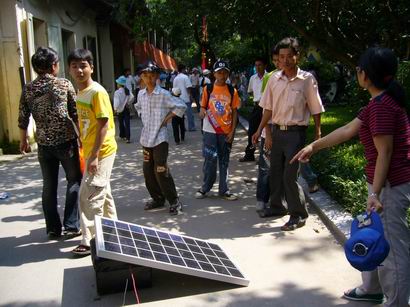
The pupils were learning how to use solar cells
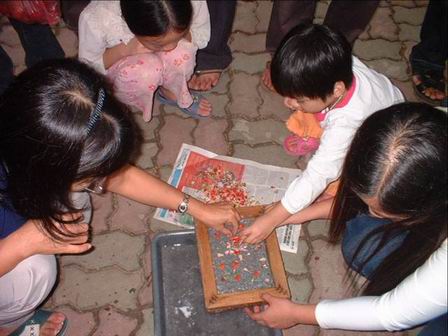 Paper Recycling Games
.jpg)
|