1 - Specific Gravity and Density
Specific gravity is defined as the ratio of the density of a substance to the density of water.
Water has a specific gravity of 1.0
2 - Any object with a specific gravity less than1.0 will float in water and anything greater than 1.0 will sink.
The human body has a density slightly less than that of water and averages a specific gravity of 0.974. Therefore, we float.
3 - Lean body mass has a typical density near 1.1 and fat mass has a density of about 0.9. Therefore, an individual who has a high percentage of lean body mass will require floatation devices. In contrast, an obese individual will have a specific gravity considerably less than 1.0 and will float more easily.
4 - Buoyancy
Buoyancy is defined as the upward thrust acting in the opposite direction to the force of gravity. This property can be used in rehabilitation to assist in movement, as resistance to movement, and as support of movement on the water’s surface.
As a person is more immersed in water, he or she weighs less. For instance, when a person is submerged up to hip height in water, he or she weighs 50% of weight on land. See the picture below.
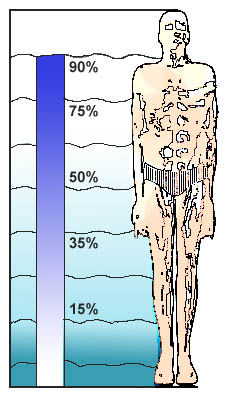 Percentage of body weight off-loaded with increasing immersion depth.
Taken from Becker BE, Cole AJ. Comprehensive Aquatic Therapy.
Boston. Butterworth-Heinemann, 1997, pp. 41.
Source: physicaltherapi.com
5 - Center of Buoyancy vs. Center of Gravity
Center of buoyancy is defined as the center of all buoyancy force movements. The human center of buoyancy is in the mid-chest. The center of gravity is a point at which all force movements are in equilibrium. The human center of gravity is located slightly posterior to the midsagittal plane and at the level of the second sacral vertebrae.
LUẬT CHƠI
- Bất kỳ ai muốn đều có thể tham gia trò chơi này;
- Có thể dịch cả bài, một phần, hoặc một vài câu trong phần nào đó, cũng có thể chỉ bình luận văn phong, ngữ pháp, cách dùng từ ... của các bài dịch khác;
- Để tiện theo dõi, hãy sử dụng hệ thống đánh số cho sẵn trong phần tiếng Anh: Câu 1, 2, 3, ...;
- Để post bài, hãy sử dụng phần "Bình luận" dưới mỗi đoạn văn đã cho. Nếu phần dịch dài, hãy post làm hai lần để phòng mất dữ liệu;
- Sau khi post, bài sẽ được Pi C&E xuất bản, nếu nội dung nằm trong phạm vi cần dịch;
- Sau 7-10 ngày, Pi C&E sẽ có bài dịch của mình để mọi người tham khảo.
- Mọi người có thể chọn gửi cho Pi C&E các bài báo tiếng Anh làm bài tập dịch theo địa chỉ [email protected]. Các bài báo không nên quá dài và quá chuyên sâu về một lĩnh vực nào đó.
|
NÀO BẮT ĐẦU THÔI
|