By Rebecca Morelle
Science reporter, BBC News, Costa Rica
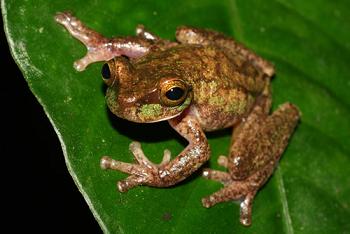
1 - An extremely rare female frog has been spotted for the first time in 20 years. The tiny tree frog, Isthmohyla rivularis, was seen in Costa Rica's Monteverde Cloud Forest Preserve. This species was thought to have become extinct two decades ago, but last year a University of Manchester researcher caught a glimpse of a male.
2 - However, the discovery of the female and more males suggests this species is breeding and has been able to survive where many other frogs have not. Andrew Gray, a herpetologist from Manchester Museum at the University of Manchester, said: "This has been the highlight of the whole of my career. "Now that we know that both sexes exist in the wild, we should intensify efforts to understand their ecology and further their conservation."
3 - The BBC has been following the team from the University of Manchester and Chester Zoo that is working on amphibian conservation programmes. The BBC video of the frog is the first-known footage of this species. The 2.5cm-long female, which was released after the discovery, was brown with metallic green speckles and was packed full of eggs.
4 - A difficult task
Finding female frogs is extremely difficult; males make a distinctive call but females are silent for most of the time. And tracking down this particular species in a great expanse of rainforest was even more difficult - the team had few clues about where the frogs might be, and the search could only take place at night. The team trekked deep into the forest to a spot close to where the male Isthmohyla rivularis was spotted last year. The researchers first discovered another male from its soft insect-like call.
5 - The conservationists then trained their torches on the undergrowth, and eventually Luis Obando, head of park maintenance at Monteverde's Tropical Science Center, found the tiny female, which was sitting on a leaf. Mr Gray told the BBC: "It is hard to describe just how unlikely it was to have discovered a female of this particular species. "The only time you ever come across a female is by chance - and it is only once in a blue moon that they come down to lay their eggs. You really have to be in the right place at the right time. "You could come out here every night for a year and not see a thing. "I really think that this time we have had luck on our side."
6 - The discovery of both sexes of this species has given the researchers hope that this population may be surviving against the odds. Mr Gray explained: "Last year, when we saw the male, we had no idea whether this was one of the last few remaining male specimens of this species. "But now we have found the female, there is hope that the species may recover.
7 - "It still seems that these critically endangered creatures are on the very brink of extinction - and although we have been intensively searching the streams all through the night, it appears that the density of the population is precarious." The researchers swabbed the frogs before they were released to see if they are carrying the chytrid fungus - a disease thought to have killed of many other species in this area.
8 - They also used a spectrometer to look at the properties of the frogs' skin to try to find out why this species has survived where others have not. "It is imperative for the future conservation of Costa Rican amphibians that collaborative efforts harness the skills of biologists, researchers, educators and committed individuals, if we are to save these rare species," Mr Gray added.
LUẬT CHƠI
- Bất kỳ ai muốn dịch đều có thể tham gia;
- Có thể dịch cả bài, một phần, hoặc một vài câu trong phần nào đó, cũng có thể chỉ bình luận văn phong, ngữ pháp, cách dùng từ ... của các bài dịch khác;
- Để tiện theo dõi, hãy sử dụng hệ thống đánh số cho sẵn trong phần tiếng Anh: Part A, B, C ...; các số thứ tự 1, 2, 3, ...;
- Để post bài, hãy sử dụng phần "Bình luận" dưới mỗi đoạn văn đã cho. Nếu phần dịch dài, hãy post làm hai lần để phòng mất dữ liệu;
- Sau khi post, bài sẽ được Pi C&E xuất bản, nếu nội dung nằm trong phạm vi cần dịch;
- Sau 7-10 ngày, Pi C&E sẽ có bài dịch của mình để mọi người tham khảo.
- Mọi người có thể chọn gửi cho Pi C&E các bài báo tiếng Anh làm bài tập dịch theo địa chỉ [email protected]. Các bài báo không nên quá dài và quá chuyên sâu về một lĩnh vực nào đó.
|
NÀO BẮT ĐẦU THÔI
|