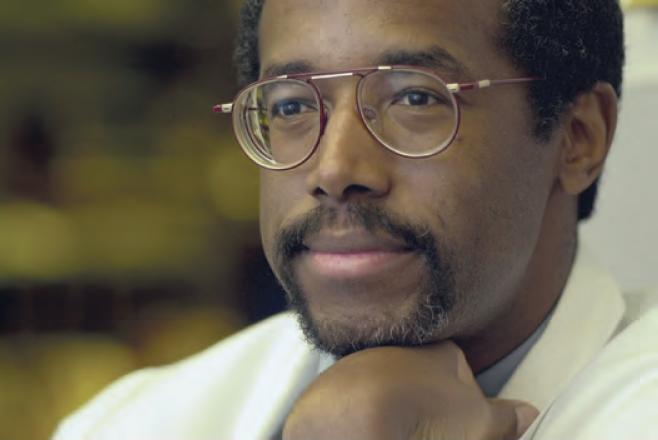
From the Big Picture: Getting perspective on what’s important, by Ben Carson with Gregg Lewis
PART A
1 - Ben Carson is the dicrector of pediatric neurosurgery at JohnHopkinHospital. But when he was an inner-city fifth-grader, no one would have predicted he would ultimately obtain a scholarship to Yale and become a famous surgeon. At mid-term in the fifth grade, he had failed almost every subject. What took him from “zero” grades to a scholarship at a prestigious university? In the selection below Ben Carson tells about the “answer” his mother found to help him and his brother. Her “answer” ultimately changed his life forever.
Looking back, Ben Carson says, “My poor mother was mortified. Here she was, with a third-grade education, working two or three jobs as a domestic, cleaning other people’s houses, knowing that life didn’t hold much for her. And seeing my brother and me going down the same road. She didn’n know what to do. So she prayed and asked God to give her wisdom. What could she do to get her young sons to understand the importance of education so that they could determine their own destiny?”
2 - God gave her the wisdom though my brother and I didn’t think it was all that wise. It was to turn off the television. From that point on she would let us watch our choice of only two or three television programs during the week. With all that spare time, we were to read two books a week from the Detroit Public Library.
I was extraordinarily unhappy about this new arrangement. All my friends were outside, having a good time. I remember my mother’s friends coming to her and saying, “You can’t keep boys in the house reading. Boys are supposed to be outside playing and developing their muscles. They will be sissies. You can’t do that!”
3 - Sometimes I would overhear this and I would say, “Listen to them, Mother.” But she would never listen. We were going to have to read those books.
Sometimes, when I tell this story, people come up to me afterwards and ask, “How was your mother able to get you to read those books? I can’t get my kids to read or to ever turn off the television or Nintendo.”
I just have to chuckle and say, “Well, back in those days, the parents ran the house. They didn’t have to get permission from the kids.” That seems to be a novel concept to a lot of people these days.
4 - At any rate, I started reading. The nice thing was my mother did not dictate what we had to read. I loved animals, so I read every animal book in the Detroit Public Lib. And when I finished those, I went on to plants. When I finished those, I went on to rocks because we lived in a dilapidated section of the city near the railroad tracks. And what is there along railroad tracks, but rocks? I would collect little boxes of rocks and take them home and get out my geology book. I would study until I could name virtually every rock, tell how it was formed, and identify where it came from.
Months passed. I was still in fifth grade. Still the dummy in the class. Nobody knew about my reading project.
One day the fifth grade science teacher walked in and held up a big shiny black rock. He asked, “Can anybody tell me what this is?”
PART B
5 - Keep in mind that I never raised my hands. I never answered questions. So I waited for some of the smart kids to raise their hands. None of them did. So I waited for some of the dumb kids to raise their hands. When none of them did, I though, This is my big chance. So I raised my hand … and everyone turned around to look. Some of my classmates were poking each other and whispering, “Look, look, Carson’s got his hand up. This is gonna be good!”
6 - They couldn’t wait to see what was going to happen. And the teacher was shocked. He said, “Benjamin?”
I said, “Mr Jaeck, that’s obsidian.” And there was silence in the room. Because it sounded good. But no one knew whether it was right or wrong. So the other kids didn’t know if they should laugh or be impressed.
Finally the teacher broke the silence and said, “That’s right! This is obsidian.”
7 - I went on to explain, “Obsidian is formed after a volcanic eruption. Lava flows down and when it hits water there is a super-cooling process. The elements coalesce, air is forced out, the surface glazes over, and …”
I suddenly realized everyone was staring at me in amazement. They couldn’t believe all this geological information spewing from the mouth of a dummy. But you know, I was perhaps the most amazed person in the room, because it dawned on me in that moment that I was no dummy.
8 - I thought, Carson, the reason you knew the answer is because you were reading those books. What if you read books about all your subjects – science, math, history, geography, socical studies? Couldn’t you then know more than all these students who tease you and call you a dummy? I must admit the idea appealed to me – to the extent that no book was safe from my grasp. I read everything I could get my hands on. If I had five minutes, I had a book. If I was in the bathroom I was reading a book. If I was waiting for the bus I was reading a book.
9 - Within a year and a half, I went from the bottom of the class to the top of the class – much to the consternation of all those students who used to tease me and call me Dummy. The same ones would come to me in seventh grade to ask, “Hey, Benny, how do you work this problem?” And I would say, “Sit at my feet, youngster, while I instruct you.”
I was perhaps a little bit obnoxious. But after all those years it felt so good to say that to those who had tormented me.
10 - The important point here is that I had the same brain when I was still at the bottom of the class as I had when I reached the top of the class.
The difference was this: in the fifth grade, I thought I was dumb so I acted like I was dumb, and I achieved like a dumb person. As a seventh grader I thought I was smart, so I acted and achieved accordingly. So what does that say about what a person thinks about his own abilities? What does this say about the importance of our self-image? What does it say about the incredible potential of the human brain our Creator has given us?
LUẬT CHƠI
- Bất kỳ ai muốn dịch đều có thể tham gia;
- Có thể dịch cả bài, một phần, hoặc một vài câu trong phần nào đó, cũng có thể chỉ bình luận văn phong, ngữ pháp, cách dùng từ ... của các bài dịch khác;
- Để tiện theo dõi, hãy sử dụng hệ thống đánh số cho sẵn trong phần tiếng Anh: Part A, B, C ...; các số thứ tự 1, 2, 3, ...;
- Để post bài, hãy sử dụng phần "Bình luận" dưới mỗi đoạn văn đã cho. Nếu phần dịch dài, hãy post làm hai lần để phòng mất dữ liệu;
- Sau khi post, bài sẽ được Pi C&E xuất bản, nếu nội dung nằm trong phạm vi cần dịch;
- Sau 7-10 ngày, Pi C&E sẽ có bài dịch của mình để mọi người tham khảo.
- Mọi người có thể chọn gửi cho Pi C&E các bài báo tiếng Anh làm bài tập dịch theo địa chỉ [email protected]. Các bài báo không nên quá dài và quá chuyên sâu về một lĩnh vực nào đó.
|
NÀO BẮT ĐẦU THÔI
|