Published: October 8, 2008
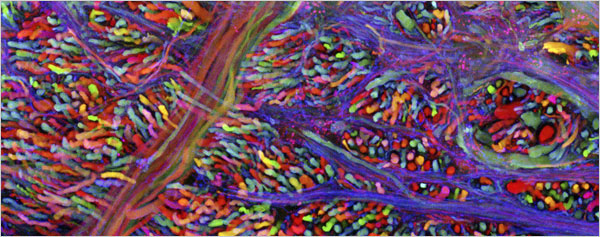
Brain cells of a laboratory mouse glowing with multicolor fluorescent proteins.
1 - One Japanese and two American scientists have won this year’s Nobel Prize in Chemistry for taking the ability of some jellyfish to glow and transforming it into a ubiquitous tool of molecular biology for watching the dance of living cells and the proteins within them. The fluorescent proteins are now routinely used for observing the growth and fate of specific cells like nerve cells damaged during Alzheimer’s disease.
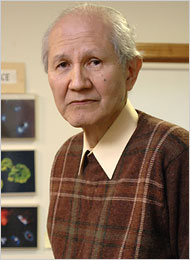 Osamu Shimomura at his home Osamu Shimomura at his home
in Falmouth, Mass. on Wednesday.
2 - The winners are Osamu Shimomura, 80, an emeritus professor at the Marine Biological Laboratory in Woods Hole, Mass., and Boston University Medical School; Martin Chalfie, 61, a professor of biological sciences at Columbia University; and Roger Y. Tsien, 56, a professor of pharmacology at the University of California, San Diego. Each will receive a third of the 10 million krona prize (about $1.4 million) awarded by the Royal Swedish Academy of Sciences.
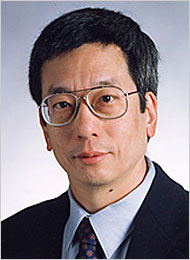 Roger Tsien
3 - Dr. Shimomura said he received a 5 a.m. phone call informing him he was a Nobelist. “The reaction was just surprise,” he said. Dr. Tsien was not caught completely unaware. Last week, the Thomson Reuters news service listed him among its predictions for this year’s Nobel Prize winners. “I didn’t want to put any credence in it,” Dr. Tsien said, noting that the predictions for the physics and medicine prizes this week were wrong. Dr. Tsien (pronounced chen) added that his work was “only one little piece” amid the work of many. “It wasn’t necessarily the case they had to give it to me,” he said. “Obviously, it’s pretty nice to hear.”
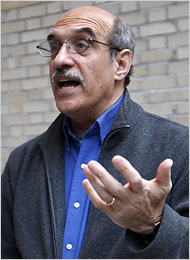 Martin Chalfie outside his apartment
in New York on Wednesday.
4 - Dr. Chalfie never received the phone call from Sweden. “I slept through it,” he acknowledged at a news conference at Columbia. He said he had inadvertently turned down the ringer on his telephone a couple of days ago. He woke up at 6:10 in the morning and thought the soft ring was coming from a neighboring apartment. “I was a little bit annoyed that they weren’t answering their phone,” he said. “I then realized because it was after 6, that they must have announced the Nobel Prize in Chemistry. I decided to find out who the schnook was that won it this year. So I opened up my laptop and found out I was the schnook.”
5 - Biologists have long observed that some sea creatures glow in the dark. In 1962, Dr. Shimomura, then a researcher at Princeton, and Frank Johnson, a Princeton biology professor, isolated a specific glowing protein in the Aequorea victoria, a jellyfish that drifts in the ocean currents off the west coast of North America. The protein looked greenish under sunlight, yellowish under a light bulb and fluorescent green under ultraviolet light. Dr. Shimomura and Dr. Johnson called it the green protein, but now it is known as green fluorescent protein, or G.F.P. for short.
6 - The green fluorescent protein consists of a chain of 238 amino acids bent into a beer can-like cylindrical shape, and for two and a half decades it remained a little-known biological curiosity. Dr. Chalfie first heard about the protein at a seminar in 1988, and thought he might be able to use it in his studies of Caenorhabditis elegans, a transparent roundworm. “It didn’t take much to realize that if I put that fluorescent protein inside this transparent animal, I would be able to see the cells that were making it,” he said. “And that’s what we set out to do.”
Note: The full article "Three Chemists Win Nobel Prize" can be found with the link below:
Source: The New York Times
LUẬT CHƠI
- Bất kỳ ai muốn dịch đều có thể tham gia;
- Có thể dịch cả bài, một phần, hoặc một vài câu trong phần nào đó, cũng có thể chỉ bình luận văn phong, ngữ pháp, cách dùng từ ... của các bài dịch khác;
- Để tiện theo dõi, hãy sử dụng hệ thống đánh số cho sẵn trong phần tiếng Anh: Part A, B, C ...; các số thứ tự 1, 2, 3, ...;
- Để post bài, hãy sử dụng phần "Bình luận" dưới mỗi đoạn văn đã cho. Nếu phần dịch dài, hãy post làm hai lần để phòng mất dữ liệu;
- Sau khi post, bài sẽ được Pi C&E xuất bản, nếu nội dung nằm trong phạm vi cần dịch;
- Sau 7-10 ngày, Pi C&E sẽ có bài dịch của mình để mọi người tham khảo.
- Mọi người có thể chọn gửi cho Pi C&E các bài báo tiếng Anh làm bài tập dịch theo địa chỉ [email protected]. Các bài báo không nên quá dài và quá chuyên sâu về một lĩnh vực nào đó.
|
NÀO BẮT ĐẦU THÔI
|